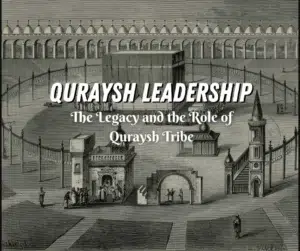
Quick answer: The Quraysh were the leading tribe of Mecca in the century before Islam. They controlled the city and acted as custodians of the Kaaba, and they grew wealthy from pilgrimage and from caravan trade. Prophet Muhammad (SAW) was born into one of their clans, Banu Hashim. Most of the tribe opposed him for about twenty years, and most of it accepted Islam after Mecca came under Muslim control in 8 AH (630 CE).
The tribe’s name appears in English in several spellings, including Quraysh, Quraish, Quresh, Qurash and the adjective Qurayshi or Qureshi. They are all the same tribe. Mecca is also written Makkah. This guide covers where the Quraysh came from, how they took control of Mecca, which clans they were divided into, what they believed before Islam, why they fought the Prophet (SAW), and what became of them afterwards. It sits alongside the rest of our Islamic history writing.
What Does the Name Quraysh Mean
No one can say for certain. Three explanations are reported, and the honest position is that the matter is unsettled.
The first derives Quraysh from qirsh, a word used for a large sea creature, with the tribal name as a diminutive form of it. The second connects it to taqarrush, meaning a gathering or coming together, which would describe how the tribe assembled in Mecca rather than naming an ancestor. The third treats it as a name attached to a specific forefather.
Because the derivations disagree, the meaning of the name is not a reliable guide to the tribe’s history. What the sources do agree on is where the Quraysh placed themselves in Arab genealogy, which is the subject of the next section.
Origins and History of the Quraysh
Historical report
The Quraysh traced their descent to Fihr ibn Malik, and through him to al-Nadr ibn Kinana. Some reports attach the tribal name at al-Nadr rather than at Fihr, which is one reason the naming question stays open. From there the Arab genealogical tradition continues the line through Adnan and back to Isma’il (Ishmael), the son of Ibrahim (Abraham). You can read more about both in our guide to the prophets and messengers in Islam.
That claimed descent mattered socially. It gave the tribe standing among the Arabs of the Hijaz well before Islam, and it connected them to the sanctuary at Mecca, which the tradition associates with Ibrahim and Isma’il.
Two cautions are worth stating plainly. These genealogies come from the Arab oral tradition and were written down later, so they are reported history rather than documented record, and the further back a line runs the less certain it becomes. And before the tribe gathered in Mecca, the descendants of Fihr are described as living in scattered groups among the wider Kinana rather than as a single organised body.
How the Quraysh Came to Control Mecca
Historical report
The turning point is Qusayy ibn Kilab, a descendant of Fihr several generations down. The sirah, meaning the biographical literature on the Prophet (SAW) and the period around him, reports that Qusayy’s father died while he was an infant, that his mother remarried and took him north towards the Syrian frontier, and that he returned to Mecca as a grown man.
Mecca at that time was held by Khuza’ah, a tribe from the south. Their chief, Hulayl ibn Hubshiyyah, gave Qusayy his daughter Hubba in marriage. After Hulayl died, the sirah reports that fighting broke out between Khuza’ah and Quraysh, and that it ended with Qusayy in control of Mecca and of the Sacred House. Accounts of exactly how the handover happened differ in their detail, and some reports describe a settlement rather than a straightforward conquest.
Qusayy then brought the scattered Qurayshi families into the city and settled them around the sanctuary, which is the point at which the Quraysh become a single political community rather than a set of related groups. He led as a senior chief, not as a king.
When Qusayy lived is disputed. One reading of the traditions places his children in the second half of the fifth century CE. Another places his own death in the second half of the sixth. The gap is large, and anyone writing about this period should say so rather than pick a date.
The Clans of the Quraysh
Historical report
Sources differ on how many clans the Quraysh had. The Encyclopaedia Britannica gives ten main clans, while detailed genealogical listings run to about fourteen. The difference is not a contradiction so much as a question of grouping, because closely related branches can be counted either as one clan or as several. Anyone who gives a single confident number is choosing one convention and not telling you.
These are the clans that matter most to early Islamic history.
| Clan | Why it is remembered |
|---|---|
| Banu Hashim | The clan of Prophet Muhammad (SAW). His grandfather Abd al-Muttalib led it. The Abbasid caliphs later came from this line. |
| Banu Zuhrah | The clan of the Prophet’s mother, Aminah. |
| Banu Taym | The clan of Abu Bakr (RA), the first caliph. |
| Banu Adi | The clan of Umar ibn al-Khattab (RA), the second caliph. |
| Banu Umayya | The clan of Uthman ibn Affan (RA), the third caliph, and of the later Umayyad caliphs. Abu Sufyan, who led Quraysh against Medina before accepting Islam, belonged to it. |
| Banu Makhzum | A wealthy and influential clan. Abu Jahl, one of the Prophet’s most determined opponents, came from it. So did Khalid ibn al-Walid (RA). |
| Banu Abd al-Dar | Held hereditary responsibilities connected with the Kaaba and the tribe’s assembly. |
| Banu Asad, Banu Sahm, Banu Jumah, Banu Nawfal, Banu Amir, Banu al-Harith, Banu al-Muttalib | The remaining clans usually listed. Their prominence varies from source to source, which is where most of the disagreement over the count comes from. |
Clan membership shaped almost everything in Meccan life: who protected you, who you married, which trade you had a share in, and which side you took when the Prophet (SAW) began to preach.
Trade, the Kaaba, and How Quraysh Grew Powerful
The winter and summer caravans
Historical report
Mecca had no farmland worth the name. Its wealth came from two linked sources: the pilgrims who travelled to the sanctuary, and long-distance trade. The Quraysh ran caravans on a seasonal cycle, travelling south towards Yemen in the winter and north towards Syria in the summer, with reported northern destinations including Gaza, Bosra and Damascus. They made agreements with the Bedouin tribes along the routes, which is what kept the caravans moving safely.
By the turn of the seventh century CE, the leading Qurayshi families were prosperous merchants, and that commercial standing is what turned religious custodianship into real political power.
Custodians of the Kaaba
Historical report
Control of the sanctuary carried practical duties, including the care of the Kaaba itself, the provision of water and food for pilgrims, and the keeping of the tribe’s war banner and council. Those responsibilities were held by particular clans and passed down within them, which gave individual families a fixed stake in the arrangement.
This is the point to hold on to for the rest of the article. The Quraysh were not merely a tribe that happened to live near a holy site. Their income, their authority over other Arab tribes and their position within their own city all rested on the sanctuary and the pilgrimage that came to it.
Surah Quraysh and What It Says
Quran
The 106th surah of the Quran is named after the tribe. It is short, and it speaks directly about the trade and the security the Quraysh enjoyed.

The argument the surah makes is worth following closely. It does not praise the caravans. It points at a favour the Quraysh already had, safe passage, food and security in a harsh region, and draws a conclusion from it: that they should worship the Lord of the House they were guarding. The complaint is not that they were traders. It is that they held the sanctuary and worshipped others alongside its Lord.
Surah Quraysh follows Surah al-Fil (105), and commentators read the two together, since al-Fil describes the failure of an attack on the sanctuary and Quraysh describes the security the Meccans enjoyed afterwards.
What the Quraysh believed before Islam
The idols at the Kaaba
Quran and historical report
The Quraysh were polytheists, and the Kaaba held a large number of idols. The Quran names three of the goddesses the Arabs of the region venerated.

Hubal, the idol most often associated with the Kaaba in accounts of this period, is named in the historical literature rather than in the Quran. That distinction is worth keeping clear: the Quran names al-Lat, al-‘Uzza and Manat, while Hubal reaches us through the sirah and the historians.
Did the Quraysh believe in Allah?
Quran
They did believe Allah existed and was the creator. This is one of the most common misunderstandings about the tribe. The Quran records their own answer when the question was put to them.
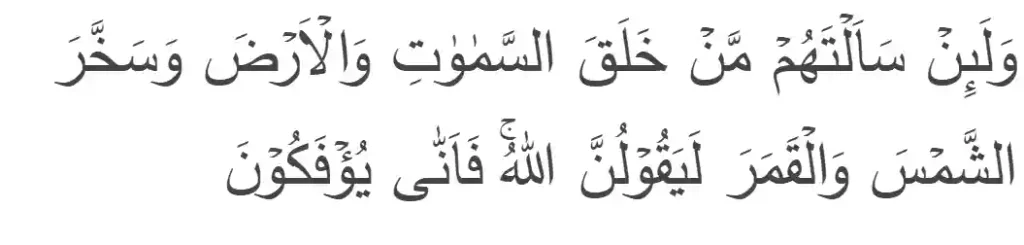
What they rejected was worshipping Him alone. The Quran also records the reason they gave for their idols.
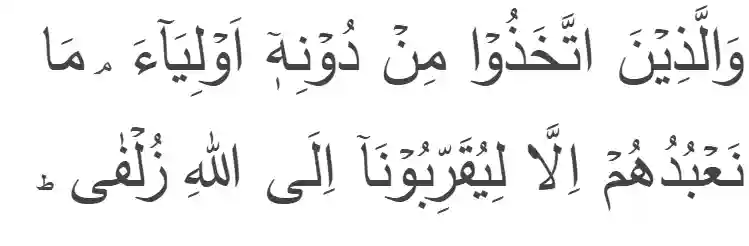
So the dispute between the Prophet (SAW) and his tribe was not about whether Allah exists. It was about whether anything may be worshipped alongside Him. That is the claim of tawhid, the oneness of Allah, and it is why the message landed as a direct challenge rather than as one more religious opinion in a tolerant marketplace.
Was the Prophet (SAW) From the Quraysh?
Historical report
Yes. Prophet Muhammad (SAW) belonged to the Quraysh tribe of Mecca, and within it to the clan of Banu Hashim. His grandfather Abd al-Muttalib led that clan, and his mother Aminah came from Banu Zuhrah, another Qurayshi clan.
This is why the early Meccan period reads the way it does. His first opponents were not strangers or a foreign power. They were his neighbours, his trading partners and in several cases his close relatives. Abu Lahab, one of his sharpest critics, was his own uncle. Our article on the life of Prophet Muhammad (SAW) follows the biography in full, and prophethood in Islam covers what the role of a prophet means.
Why the Quraysh Opposed the Prophet (SAW)
Historical interpretation
The sirah and the historians explain the opposition through three connected pressures. These are explanations drawn from the sources rather than a list the Quraysh wrote down about themselves.
The first is religious authority. The Quraysh were the custodians of a sanctuary that other Arab tribes came to, and the idols in it were part of what drew them. A message that said those idols were worthless did not simply disagree with Meccan belief. It removed the basis of Meccan standing among the Arabs.
The second is money. Pilgrimage and the trade around it were the city’s economy, and the leading families held their positions inside that system. The surah named after them makes the point from the other direction: the security and provision they enjoyed were a favour, not an achievement.
The third is social order. Mecca was organised by clan, lineage and wealth. A message that made justice and equity a religious obligation, and that gave the needy and the enslaved standing before Allah equal to that of a Qurayshi chief, was read by the leadership as an attack on the hierarchy they sat at the top of. Several of the earliest Muslims came from exactly the groups that hierarchy ranked lowest.
The leading opponents
Abu Jahl, of Banu Makhzum, was among the most persistent. Abu Lahab, of Banu Hashim and the Prophet’s own uncle, is the subject of our article on Abu Lahab’s opposition to the Prophet (SAW). A person named Abu Sufyan ibn Harb, of Banu Umayya, led Quraysh in the years of fighting with Medina and then accepted Islam when Mecca came under Muslim control, which is a reminder that the opposition was not a fixed group of permanent enemies.
The Years of Conflict With Medina
Historical report
After the migration to Medina, where the Constitution of Medina set the terms of the new community, the dispute became an armed one. CE equivalents for early Hijri years are approximate, because the two calendars do not align cleanly.
| Event | Date | What it meant for the Quraysh |
|---|---|---|
| The Battle of Badr | 2 AH / 624 CE | A smaller Muslim force defeated a larger Qurayshi one. Several senior Meccan leaders were killed. |
| The Battle of Uhud | 3 AH / 625 CE | A costly reversal for the Muslims, and a recovery of Qurayshi confidence that did not translate into control of Medina. |
| The Battle of the Trench | 5 AH / 627 CE | Quraysh and allied tribes besieged Medina and withdrew without taking it. The military route had reached its limit. |
| The Treaty of Hudaybiyyah | 6 AH / 628 CE | A negotiated truce, reported in the sirah as being for ten years. Quraysh dealt with the Muslims as a recognised party for the first time. |
| The conquest of Mecca | 8 AH / 630 CE | After the truce broke down, the Muslims entered Mecca with almost no fighting. Qurayshi control of the city ended. |
Each of these events has its own article on Islamic Mentors, linked above, and this page deliberately keeps to what each one meant for the tribe rather than retelling the battles.
What Happened to the Quraysh After the Conquest of Mecca
Historical report
The outcome is the part of the story most summaries rush past. Most of the Qurayshi leadership accepted Islam, and the tribe was not displaced or broken up. It moved into the centre of the new community.
Within a generation the pattern is clear enough to read off the clan table above. Abu Bakr (RA) came from Banu Taym, Umar (RA) from Banu Adi, Uthman (RA) from Banu Umayya, and Ali (RA) from Banu Hashim. The Umayyad caliphate came from Banu Umayya and the Abbasid caliphate from the line of Banu Hashim. Khalid ibn al-Walid (RA), of Banu Makhzum, fought against the Muslims at Uhud and later commanded their armies.
So the tribe that held the Kaaba against the Prophet (SAW) is the same tribe that supplied the leadership of the community he founded. If you want to understand how that happened individually rather than politically, our article on converting to Islam covers what acceptance of the faith involves.
What Islam Says About Qurayshi Descent
Agreed by all four Sunni schools
Descent from the Quraysh does not give a person higher standing before Allah. This is not a matter the Sunni schools of law differ on. Surah Al-Hujurat 49:13 states that people were made into nations and tribes so that they would come to know one another, and that the most honoured before Allah is the one with the most taqwa, meaning mindfulness of Allah. Lineage is described there as a fact of human variety, not a ladder of rank.
Narration grade: Sahih
Readers often ask about a hadith connecting the Quraysh to leadership. It is recorded in Sahih al-Bukhari, in the Book of Virtues and Merits, in the chapter on the virtues of Quraysh, as hadith 3500, narrated through Muhammad ibn Jubayr ibn Mut’im. In it the Prophet (SAW) is reported as saying that this matter, meaning authority, will remain with Quraysh, with a condition attached about their upholding the religion. The narration is authentic by its inclusion in Sahih al-Bukhari. You can read about the collection it comes from in our guide to the six authentic hadith books.
What that hadith means in practice has been discussed by scholars for centuries, and it belongs to the classical literature on political authority rather than to everyday practice. It is a statement about who holds the caliphate, not a statement that a person with Qurayshi ancestry today has a religious rank above other Muslims. On that second question, Surah Al-Hujurat 49:13 settles the matter.
This is educational information. For your own situation, ask a qualified scholar.
Do the Quraysh Still Exist Today
Historical report
Yes. Descendants of the Quraysh still exist. Islamweb’s Fatwa Center confirmed this in Fatwa 215560, dated 22 August 2013, and advised anyone wanting to identify members of the tribe to consult genealogists, noting that establishing a lineage falls outside what a fatwa service can do.
Families claiming Qurayshi descent are found across the Arab world, South Asia, Africa and beyond, and the surnames Qureshi, Quraishi and Qurashi are common in several of those regions. Two points follow from this, and both matter.
A surname on its own does not establish descent. Names travel for many reasons, including conversion, patronage, regional custom and simple adoption of a respected name, and no website can verify an individual claim. Genealogists working from documented chains are the only honest route for anyone who wants to establish their own.
And as the previous section sets out, even an established lineage would not place a person above another Muslim in the sight of Allah. The Quraysh are a subject of history, not a rank.
Frequently Asked Questions
How many clans did the Quraysh have?
Sources differ. Britannica gives ten main clans, while detailed genealogical listings run to about fourteen, because the count depends on how closely related branches are grouped. The clans that matter most to early Islamic history are Banu Hashim, Banu Zuhrah, Banu Taym, Banu Adi, Banu Umayya and Banu Makhzum.
Which tribe was Prophet Muhammad (SAW) from?
The Quraysh, and within it the clan of Banu Hashim. His grandfather Abd al-Muttalib led that clan.
Who was the leader of the Quraysh?
The Quraysh had no single ruler. Authority sat with the heads of the clans and with the men who held the hereditary responsibilities connected to the Kaaba. Qusayy ibn Kilab is the figure credited with bringing the clans together in Mecca, and Abu Sufyan ibn Harb led the tribe during the years of conflict with Medina.
Were the Quraysh good or bad?
The question does not fit the tribe, because the Quraysh were not a faction. The same tribe produced the Prophet (SAW) and his family, his fiercest opponents, and the first caliphs of Islam. Most of it opposed him for roughly twenty years and most of it then accepted his message.
Were the Quraysh Jewish?
No. The Quraysh were Arab polytheists before Islam. Jewish tribes lived in Arabia, particularly around Medina, but the Quraysh were not among them.
Did the Quraysh tribe accept Islam?
Most of it did, chiefly after Mecca came under Muslim control in 8 AH (630 CE), though individual Qurayshis had accepted Islam from the earliest years in Mecca.
What does the name Quraysh mean?
It is uncertain. Reported explanations connect it to a word for a large sea creature, to a term meaning gathering or coming together, and to the name of a forefather. None is established.
The Quraysh matter in Islamic history because the story runs both ways through them. The tribe that held the Kaaba and fought the Prophet (SAW) for twenty years is the same tribe that produced him, and most of its leading families eventually accepted the message they had resisted. If you want to follow what happened next, the conquest of Mecca and the early caliphate are where this thread continues.